
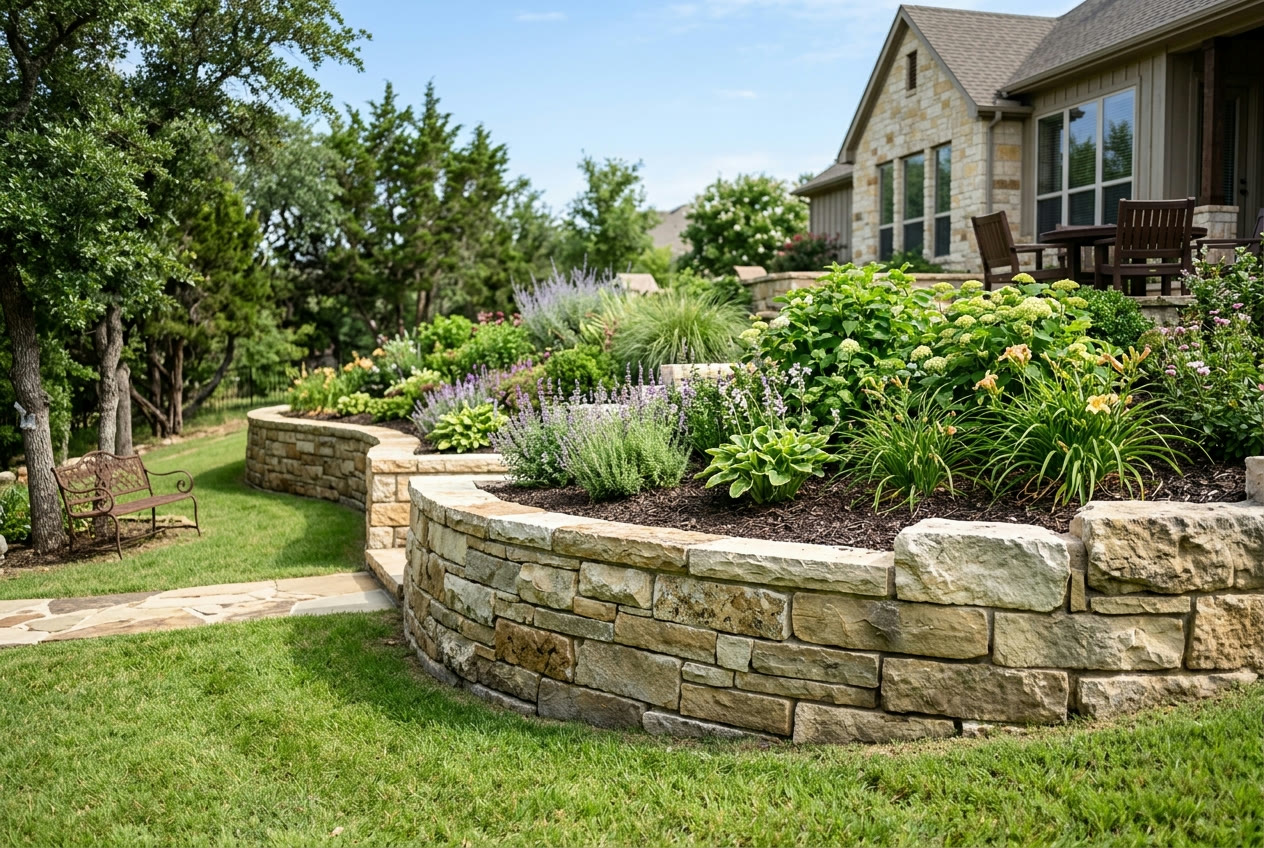
A good chunk of our retaining wall work is replacing walls somebody else built. That's not a brag, it's a pattern, and the pattern teaches you what matters. If you're pricing a wall for a slope, a flowerbed, or a driveway cut, here's what we've learned pulling the failed ones out.
Why Walls Fail Here
East Texas sits on clay, and clay doesn't sit still. It swells when it rains and shrinks hard through late summer, and a retaining wall gets that movement from two directions: the soil it's holding back and the ground under its own footing. A wall built like it would be on stable sandy ground doesn't stand a fair chance here.
Water does the rest. Rain soaks into the slope behind the wall, and if it has nowhere to go, it stacks up and pushes. Saturated clay is heavy, and hydrostatic pressure doesn't take days off. The wall leans a little more each wet season until a joint lets go. Most failed walls we tear out have one thing in common: no drainage behind them. No gravel, no weep holes, no pipe. Just stone stacked against wet clay, doing its best.
Materials Compared
Three builds cover most of the walls we do. Rough comparison first, details after.
| Build | Look | Typical Use | Relative Cost |
|---|---|---|---|
| Dry-stacked stone | Natural, rustic, no visible mortar | Garden walls, borders, low terraces | $ |
| Mortared stone | Solid, traditional, clean joints | Mid-height walls, steps, seating walls | $$ |
| Block core with stone veneer | Any stone or brick finish you want | Taller structural walls, driveway cuts | $$$ |
Dry-stacked walls rely on weight and batter (a slight backward lean) instead of mortar, and they drain naturally through the joints, which suits our clay well at low heights. Mortared stone gives you a solid, permanent wall for terraces and beds with some height to them, as long as the drainage behind it is done right. For tall or load-bearing walls, we build a reinforced concrete block core on a proper footing and face it with the stone or brick you want, so you get engineering-grade strength that still looks like a stone wall.
Drainage Is the Whole Game
If you remember one thing from this page, make it this: you're not just building a wall, you're building a drainage system with a wall on the front of it.
Behind every mortared or block wall we build goes clean gravel backfill, not the clay we dug out. Gravel gives water a fast path down instead of letting it press against the wall. At the bottom, weep holes through the face or a perforated drain pipe carry that water out and away. And the footing gets dug below the zone where clay moves most, sized for the wall it carries. None of this shows in the finished photos. All of it is why the wall is still plumb in twenty years.
When someone quotes you a wall noticeably cheaper than everyone else, this is usually what's missing. Stone against dirt looks identical to stone against gravel on the day you write the check. It doesn't look identical after three wet winters.
When You Need Engineering
Short walls are mason's work. Taller walls become structural engineering, and there's a point where a stamped design stops being optional. The common threshold is around four feet of retained height, but requirements vary by county and city, and a slope, fence, or driveway pushing on the wall from above can lower it. We help you check what applies to your property, and if your wall needs an engineer, we'll tell you straight and build to the design. A wall holding back a driveway is not the place to wing it.
Typical Cost Ranges
Honest answer: retaining walls range too widely for one number, because length, height, material, drainage, and how close our equipment can get all move the price. Small garden and flowerbed walls typically start in the low thousands. Longer or taller structural walls with footings, gravel, and drain pipe run well beyond that, and engineered walls sit at the top.
Every wall we do gets quoted individually, in writing, after we've walked the site, and the quote costs you nothing. Be wary of anyone pricing a retaining wall over the phone. If they haven't seen the slope and the soil, they're guessing with your money.
Flowerbeds and Borders
Not every wall is holding back a hillside. Stone flowerbed borders and low planter walls are some of our favorite work: small jobs, big difference in how the yard looks, and they use the same craft at a friendlier price. A mortared stone bed border also outlives every plastic and timber edging product ever sold, so you buy it once.
If you've got a slope that's creeping, a wall that's leaning, or beds you want built right, look at our retaining walls and flowerbeds page, or request a free estimate and we'll come walk the site.