
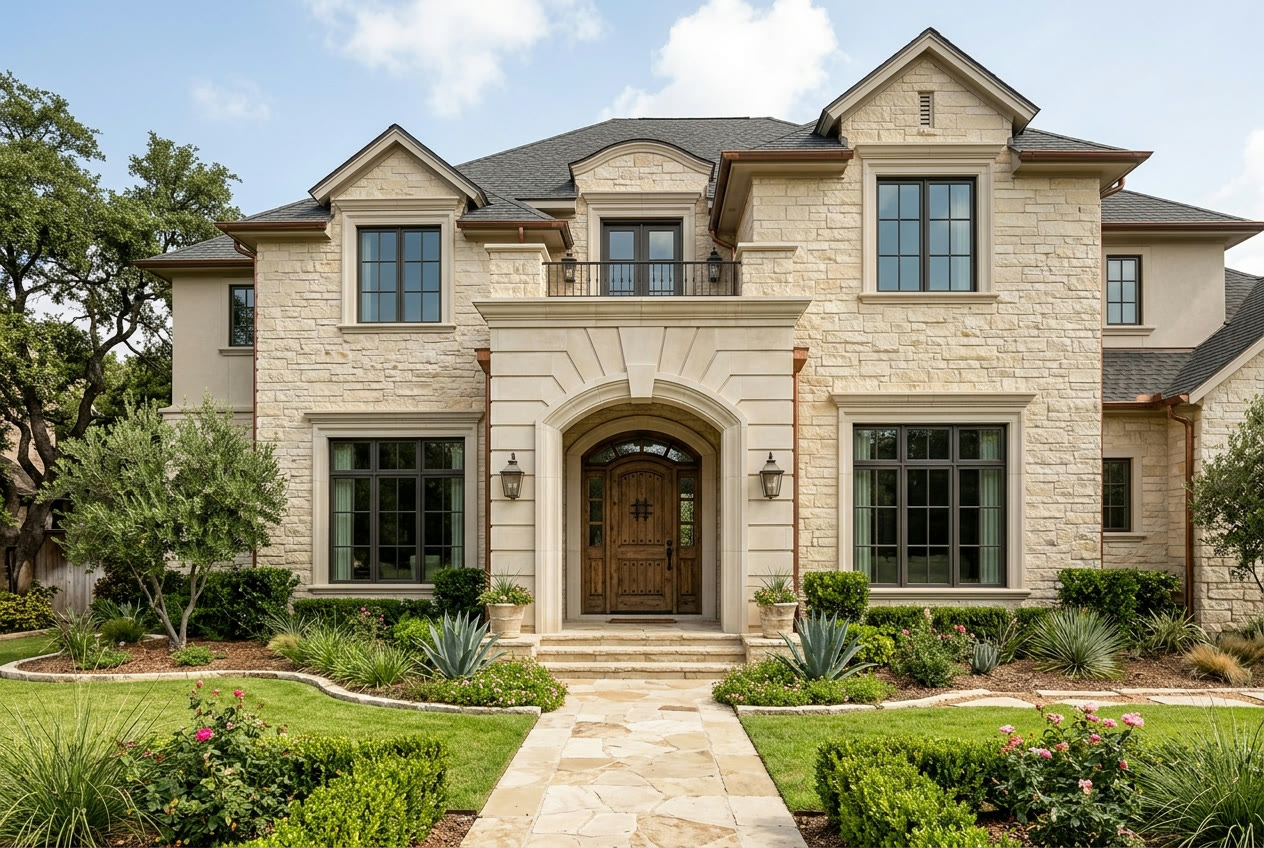
We get called out for veneer work all over Rains and Wood County, and the first question is almost always the same: stone or brick? The truthful answer is that all three common options, natural stone, manufactured stone, and brick, are good materials when they're installed right. They just fit different houses and different budgets. Here's the plain version of what we tell people at the kitchen table.
The Quick Comparison
| Natural Stone | Manufactured Stone | Brick | |
|---|---|---|---|
| Look | One of a kind, ages beautifully | Very good from the curb, patterns can repeat | Classic, uniform, timeless |
| Cost level | Highest | Lowest to middle | Middle |
| Maintenance | Very low, occasional repointing | Low, keep sealant and flashing sound | Low, mortar joints eventually need attention |
| Weight / structure | Heavy, needs a proper ledge or footing | Light, goes on most walls | Heavy, needs a brick ledge |
Natural Stone
Real rock, quarried and cut. Around here that usually means Texas limestone, sandstone, or Oklahoma flagstone. No two pieces match, and that's the whole point. A natural stone front catches evening light in a way nothing man-made quite does, and it only looks better as it weathers.
The trade-offs are weight and price. Full-thickness stone needs a footing or ledge to sit on, and laying it is slow, skilled work. You're paying for material and for hours. Thin-cut natural veneer splits the difference: real stone faces at lower weight, though still above manufactured on cost. If you want the house to feel like it grew out of the ground, this is the pick.
Manufactured Stone
Concrete cast in molds taken from real stone, colored through. The good brands have gotten genuinely hard to spot from twenty feet, and the price makes projects possible that natural stone would put out of reach. It's also light enough to go over most existing walls without new footings, which makes it the usual answer for remodels, fireplace refacing, and skirting.
Two honest cautions. First, quality varies a lot between brands, and cheap product fades. We'll tell you which lines we trust. Second, manufactured stone is less forgiving of sloppy installation. It needs correct moisture barriers and flashing behind it, or water gets trapped against the wall. Most manufactured stone failures we're called to fix were installation failures, not material failures.
Brick
Brick has been the default in Texas for a century for good reason. It's durable, it's uniform, it shrugs off sun, and every mason alive knows how to work with it. Cost usually lands between manufactured and natural stone, and matching brick on an addition or repair is straightforward because manufacturers keep long-running product lines.
The knock on brick is that it doesn't stand out. On a street where every house is brick, it disappears. That's either a bug or a feature depending on your taste. A lot of our jobs mix the two: brick body with stone accents on the entry or chimney, which adds character without natural-stone pricing across the whole house.
How East Texas Weather Factors In
Our summers cook. All three materials handle heat fine, but dark manufactured stone in full western sun will show fading sooner than natural stone or fired brick, so pick a quality product and a lighter color if that's your exposure.
The bigger local issue is under your feet. East Texas clay swells when it rains and shrinks hard in August, and that movement travels up into whatever sits on it. Heavy veneer on a shallow or undersized footing will crack at the mortar joints as the ground moves. This is why we care so much about what the veneer sits on, and why we look at your foundation before we quote. Gutters and drainage that keep water from pooling against the slab do more for your masonry's lifespan than any material choice.
Our Honest Take
There's no winner. It depends on the house, the exposure, and the budget. If money weren't a factor, we'd lay natural stone all day. Money is a factor, and good manufactured stone or brick gets you 90 percent of the effect for a lot less. What we won't do is talk you into the expensive option when the affordable one suits your house better.
The easiest way to decide is to see the materials in person. We'll bring samples out, hold them against your existing exterior in your actual light, and price the job both ways so you're comparing real numbers instead of guesses. Read more about our stone and brick veneer work, or get a free estimate and we'll bring the samples to you.